


Healthquill Team and Bhartijay
April 21, 2026: In 2011, sociologist Javier Auyero spent six months sitting in a welfare office in Buenos Aires. He was not there for benefits. He was there to watch and observe the politics of waiting. What he documented, the shuffling feet, the recycled forms, the faces drained of urgency, became one of the most unsettling findings in modern political sociology. The poor, he concluded, do not simply wait longer than everyone else. They are taught, through the waiting itself, a specific and devastating lesson about their place in the social order.
“While waiting,” Auyero wrote in Patients of the State: The Politics of Waiting in Argentina, “the poor learn the opposite of citizenship. They learn to be patients of the state.”
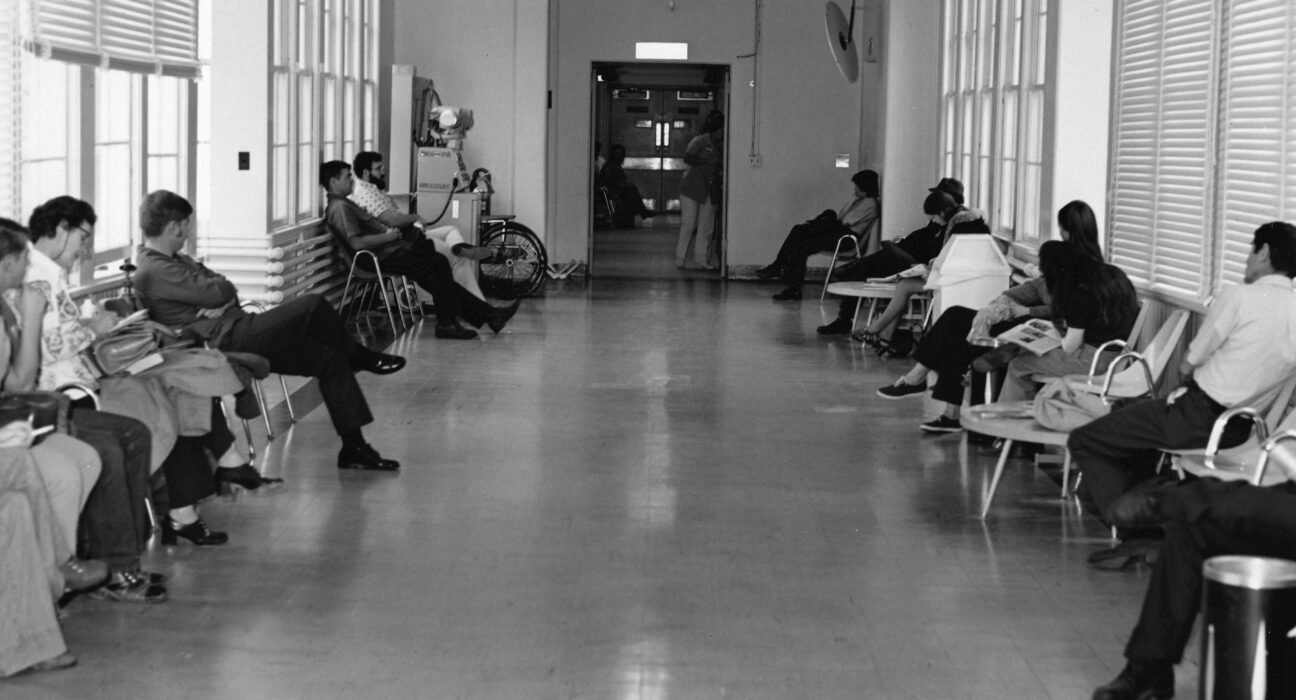
The waiting room, in other words, is not a bureaucratic failure. It is a feature. You may ask, why this article? Because it replicates exactly the progression of feelings in innumerable waiting rooms. Be it a hospital waiting room, a visa office, a government office or even a simple waiting room for whatever purpose. The anxiety, the restlessness, and then the resignation to whatever awaits seems to be a universal phenomenon for the ‘ordinary citizen’. The global wars and the populist states dominating the world stage have further marginalised the health rights of citizens where only a privileged few have access and the large swath (including the middle class) are left ‘waiting’. Case in point are the One Big Beautiful Bill’s $187 billion SNAP cuts, the UK Labour welfare reductions, the global austerity wave across 143 countries. The WHO has verified over 735 attacks on healthcare in Gaza, and the deaths of more than 1,000 healthcare workers. The GHF aid distribution says at least 1,400 Palestinians killed while attempting to access aid.
Healthquill, being India-based, cannot ignore the home country. The Indian Union government’s health spending is at 0.27% of GDP. The out-of-pocket expenditure burden stands at 47% with nearly 400 million uninsured Indians. A published study in PLOS One examining waiting times and caste in India found that socioeconomically disadvantaged groups face longer waits and, as a result, lower utilisation, compounding an already stark health divide. The Ayushman Bharat real-world failure story from Mumbai in July 2025 where a daughter of a card holder called eight Ayush cited hospitals before giving up, all connect to Auyero’s thesis that the right exists but the complexity of claiming it is the mechanism of exclusion.
The architecture of exhaustion
Auyero’s research was conducted at the main welfare office in Buenos Aires, at immigration registration lines, and among shantytown residents awaiting housing allocation. It revealed something that is easy to feel but difficult to name: that the state governs the poor not only through policy but through time. The confusion about administrative processes, the uncertainty about when or whether help will arrive, the physical and psychological cost of returning again and again to ask the same question; these are not accidents of underfunding. They are the texture of domination.
The concept connects directly to what Princeton scholar Rob Nixon called “slow violence” in his 2011 book of the same name. Nixon coined the term to describe harm that is “gradual and out of sight”, namely: environmental degradation, toxic drift, poverty, which unfold too slowly to generate outrage, and therefore unfold almost without interruption. Bureaucratic waiting is slow violence in its administrative form. No single encounter in a government office constitutes an emergency. But across a lifetime, the hours surrendered to queues, the wages lost to mandatory appointments, the benefits missed because paperwork expired while you were working, all these accumulate into cruel denial of access.
French anthropologist Marc Augé in his 1992 essay Non-Places: Introduction to an Anthropology of Supermodernity, described waiting rooms, transit lounges, and government offices as non-places that are environments stripped of relational history, of identity, of any meaning beyond the transactional. They are spaces where individuals are connected in a “uniform manner” and where no organic social life is possible.
Data behind the experience
The phenomenology has always been knowable to anyone who has sat in one of these rooms. Now the empirical record is catching up.
Research published in NPR in 2023 based on time-use data found that on an average day, people with low incomes are one percentage point more likely to wait, three percentage points more likely to wait when using services, and spend an additional minute waiting per episode compared to high-income people, translating to an annual waiting time of roughly 7.5 hours for high-income individuals versus 13.6 hours for those with low incomes. The same analysis noted that Medicaid patients consistently face longer waiting rooms than those with private insurance, and that people in economically disadvantaged circumstances are more likely to interact with government systems “in more burdensome ways. Research on England’s National Health Service similarly found differences in waiting times of up to 35% or 43 days between the most and least deprived patient groups for non-emergency coronary procedures.
The inequality is not only about waiting to see a doctor. In the United States, over 710,000 people were on waiting lists or interest lists for Medicaid Home and Community-Based Services in 2024, with the average wait time reaching 40 months, and closer to 50 months for people with intellectual or developmental disabilities. These are people who have already been assessed as eligible. They are not waiting to find out if they qualify. They are waiting because there is no room for them yet. The state said yes, and then made them wait anyway.
India’s paper queues, US’ work requirements
The geography of bureaucratic waiting is global, but its logic is consistent: complexity is deployed where power is absent. In India, accessing even basic entitlements — a ration card, MGNREGA wages, a Pradhan Mantri Awas Yojana housing application, involves a process of form collection, biometric verification, local official sign-off, and repeated visits that fall overwhelmingly on those least equipped to absorb the cost. Research on MGNREGA published in The Manchester School in 2024 documented how administrative delays in wage payments compound existing poverty, affecting household welfare through both direct income loss and the erosion of planning capacity. Rural workers entitled to 100 days of employment often receive payment weeks after the work is completed, during which time they must absorb costs on credit. The system guarantees the right; the implementation guarantees the wait.
In the United States, the mechanism is more formally codified. Work requirements attached to SNAP and Medicaid, the subject of intense Congressional debate through 2024 and 2025, function not primarily as employment incentives but as administrative filters. Evidence from states that implemented work requirements shows that many eligible individuals lost coverage due to administrative hurdles, lack of internet access, or difficulty proving their exemptions, with the Congressional Budget Office concluding that Medicaid work requirements would lead to coverage loss with “no change in employment or hours worked.” The burden of proof, and the cost of producing it, falls on those with the least flexibility to do so.
A West Health–Gallup survey tracking healthcare access since 2018 found that by 2024, disparities in access to healthcare based on race, ethnicity, and income had reached their highest point since tracking began, with the sharpest increases among Hispanic (up 8 percentage points) and Black (up 5 percentage points) adults and lowest-income households earning under $24,000 a year, which saw a 25% increase in cost desperation while White adults and middle-to-high-income households saw no significant change.
Time as the currency of inequality
What unites these datasets is a concept scholars call “time poverty.” Published in Nature Human Behaviour in 2020 , time poverty describes the condition of having insufficient discretionary time to meet basic needs and sustain wellbeing and it maps almost exactly onto income poverty. People who cannot afford to outsource tasks, who work variable-hour low-wage jobs, who live far from services and cannot afford transportation, who must physically appear at offices rather than being served digitally, these are the same people.
Kafka’s The Trial (1915) and The Castle (1926) built the poverty architecture accurately. His protagonists encounter systems that are not hostile. They are not refused, nor prosecuted without cause, they are met with systems that are imply impossible to navigate. The machinery processes them endlessly without resolution. The terror is not cruelty but procedure.
What Kafka dramatised as nightmare, Auyero documented as ethnography.
The health consequences of the wait
Delayed access to care, whether from waiting lists, work requirements, documentation barriers, or the simple cost of taking a day off without pay is not neutral, it turns an event from manageable to acute and eventually to crisis. Emergency room visits, higher medication costs, advanced disease stages: these are what wait times produce downstream.
The psychological dimension is what Auyero called a kind of “docility” , a learned helplessness that extends beyond the welfare offices. When the state consistently signals that your time has no value, when you must return six times to submit the same form, the effect is not merely inconvenience. It is an erosion of agency, of the belief that asking will produce an answer, of what psychologists would recognise as internal locus of control. Chronic uncertainty and the inability to plan are independently associated with elevated cortisol, disrupted sleep, and worsening mental health outcomes.
While wealthy suburbs are saturated with private clinics and high-speed telehealth options, low-income minority neighbourhoods are struggling with healthcare deserts — areas where local hospitals are underfunded and overcrowded, leaving residents with longer wait times and fewer specialists. Telehealth, often held up as the democratising alternative, sees the same pattern of unequal digital distribution and access.
Auyero’s argument, supported by the pattern visible across countries and contexts, is that waiting functions as governance. There is apparent access without results with no political cost of explicit denial. It disciplines claimants into dependency while maintaining the formal architecture of rights. The state never says no. It simply schedules the answer for later.
The rich do not wait in these rooms. They have private navigators, concierge physicians, and people who know which form supersedes which. The middle class encounter mild friction and downstream the same marginalisation. The poor encounter a system whose complexity exceeds their available time, whose office hours conflict with their shift patterns. The waiting room is not inefficient. It is pedagogical.
And until the systems that create it are understood as exercises of power and just not administrative shortfalls, health equity, social equity, and meaningful citizenship will remain aspirations.