

HQ Staff Writer
March 13, 2026: A significant El Niño event is forecast to develop later in 2026, according to multiple weather tracking agencies. The current weak La Niña pattern is ongoing but is expected to transition to creating conditions for a “super”El Niño. Most prediction models point to its emergence during June-August or fall of 2026, peaking in the winters.
Multiple leading agencies are in consensus, that a record-breaking “super” El Niño with a classic but intensified set of disruptive weather patterns worldwide is forming:
The National Oceanic and Atmospheric Administration’s (NOAA’s) Climate Prediction Center (CPC) states there is a 62% chance of El Niño emerging in June-August 2026 and persisting through the end of the year. Their models show about 80% of forecasters cross the El Niño threshold by early fall.
The World Meteorological Organization (WMO) reports a moderate chance of El Niño returning in 2026, with its Global Producing Centres indicating probabilities around 40% for May-July and rising thereafter.
The European Centre for Medium-Range Weather Forecasts (ECMWF) and other international climate models are also signaling the development of a potentially strong event.
Private climate firms like the Climate Impact Company are also analyzing the trend, with some suggesting a “big El Niño” in 2026 could be followed by a return to La Niña in 2027.
Forecasters believe that there are serious chances of this becoming a “super El Niño”—a term used for the most powerful events. Models suggest it could rival or exceed the strength of the historic 1997-98 and 2015-16 events.
Like all El Niños, it will involve a collapse of the normal Pacific trade winds and a massive eastward shift of warm surface waters from the western Pacific toward the Americas.
Crucially, this event would be superimposed on a background of ongoing anthropogenic climate change. The ocean and atmosphere are already warmer, meaning this El Niño could push global average temperatures to new all-time records and its relative intensity could be greater than past “super” events due to the higher baseline heat. It would act as a short-term spike on the long-term warming trend, temporarily accelerating the rate of global temperature increase. It may also influence the timing of crossing longer-term climate thresholds.
Is a Massive El Niño Imminent?
It is very likely to make 2026 or 2027 the warmest year on record, surpassing 2024. The excess heat stored in the Pacific will be released into the atmosphere globally.
The southern U.S. and northern Mexico would see increased storminess and flooding risk during winter, while the northern U.S. and Canada could experience milder, drier, and warmer-than-average conditions.
Indonesia, the Philippines, Australia, and parts of Southeast Asia will face drought and h heightened wildfire risks.
The west coast, particularly Peru and Ecuador, faces a high risk of severe flooding and landslides.
El Niño typically suppresses Atlantic hurricane activity by increasing vertical wind shear, while potentially enhancing activity in the central and eastern Pacific basins.
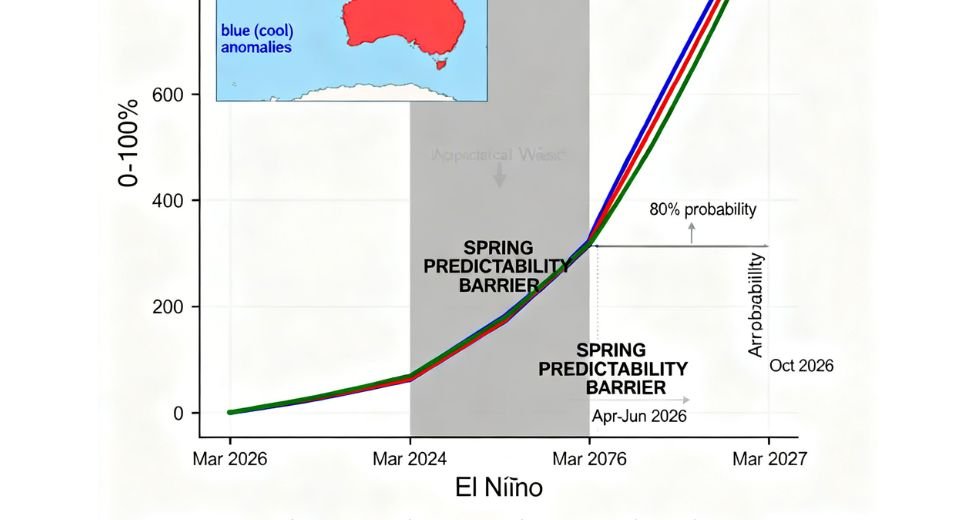
Forecasters consistently emphasize the “spring predictability barrier”, a period of lower forecast skill for ENSO (El Niño-Southern Oscillation) during the Northern Hemisphere spring. While the signal is strong in current models, the exact timing, intensity, and precise regional impacts could still change as we approach summer.
Global impact of El Niño
The El Niño effect can lead to extreme droughts and floods that directly damage crop production and livestock, triggering widespread food crises.
The 2015-2016 El Niño, one of the strongest on record, affected an estimated 60 million people globally through food insecurity. More recently, it was noted that El Niño could impact the food security of 110 million people in a single year. The legacy of these events includes persistent food security pain and higher rates of malnutrition long after the weather event subsides.
Research shows that the economic damage extends far beyond the event year. A study analyzing the two strongest El Niños (1982-83 and 1997-98) found that the global economy lost 4.1 trillion and 5.7 trillion, respectively, in the five years following each event . The 2015-2016 El Niño event led to a cumulative loss of $5.7 trillion in global income (GDP) over the following five years.
This persistent loss is attributed to reduced investment, lower productivity, and long-term damage to capital stock.