HQ Team
August 21, 2026: The International Coordinating Group on Vaccine Provision (ICG), a coalition of health groups including the World Health Organization, has released 70,000 doses of its experimental Ervebo vaccine to the Democratic Republic of the Congo to assess its effectiveness in combating the Bundibugyo Ebola virus disease.
A week ago, Congo requested the group to release vaccines from its stockpile for the current Bundibugyo virus disease outbreak.
The 70,000 doses include 20,000 for an end-stage clinical trial to gauge its impact on the Bundibugyo virus, and 50,000 for frontline health workers in line with the current recommendations of the WHO Strategic Advisory Group of Experts on Immunization (SAGE), according to a WHO statement.
This would mean that some residents of areas affected by the outbreak could receive the vaccine outside the trial, although severe side effects from the Ervebo vaccine are very rare, according to clinical trials.
WHO Director-General Tedros Adhanom Ghebreyesus welcomed the release on Thursday, calling the move “an important example of global solidarity in action.”
It is not known whether Ervebo may be protective against the Bundibugyo virus in humans. Early laboratory and animal data suggest it may provide some protection, according to the statement.
WHO, IFRC, UNICEF
The clinical trial is expected to provide important new evidence, essential for policy-makers to inform future use of the Ervebo vaccine. “It is key that the people offered the vaccine, in the trial and otherwise, receive information on the risks, potential benefits and limitations related to the use of the vaccine in an outbreak of Bundibugyo virus and can provide informed consent.”
Ervebo vaccine is licensed and recommended for outbreaks of Ebola virus disease (previously, called Zaire ebolavirus).
The ICG partners include the World Health Organization, the International Federation of the Red Cross and Red Crescent Societies, Médecins Sans Frontières and UNICEF.
The core mandate of the ICG is to improve availability and ensure equitable access to licensed vaccines for cholera, meningitis, yellow fever, and Ebola virus disease during outbreaks.
‘Scientific evidence’
Gavi, the Vaccine Alliance, provides funding for the stockpile.
The ICG has managed the emergency stockpile of Ebola vaccine since January 2021, created as an additional tool to control Ebola virus outbreaks.
Since the establishment of the ICG Ebola mechanism in 2021, as of July 2026, more than 56,000 doses of the Ervebo vaccine have been allocated to respond to Ebola virus outbreaks in Congo. An additional 67,000 doses have been used in preventive campaigns for health and frontline workers in Congo, Guinea-Bissau, Kenya, Sierra Leone and Uganda.
Africa CDC (Centers for Disease Control and Prevention) and WHO are united in support of the Congo government to protect affected communities, save lives and bring the Bundibugyo Ebola outbreak to an end, “while generating the scientific evidence needed to strengthen Africa’s preparedness for future outbreaks,” according to the statement.
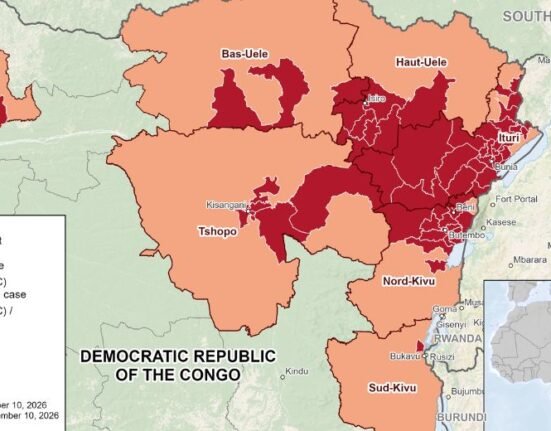
The Bundibugyo species of Ebola, which has no approved vaccines or treatments, has killed 2,325 people, becoming the deadliest in the central African country of the Democratic Republic of Congo. The death toll has surpassed the 2018-2020 outbreak of 2,299, which was previously the country’s worst on record, according to government data.